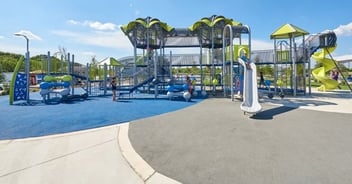
When planning a new playground, the equipment often gets most of the attention. Slides, climbers, swings and activity panels may define how children experience the space, but what goes underneath that equipment is just as important.
Playground surfacing affects accessibility, safety, maintenance, appearance and the long-term cost of the entire play area.
For schools, parks, churches, HOAs, childcare centers and other organizations planning a commercial playground, three popular surfacing choices are poured-in-place (PIP) rubber, engineered wood fiber (EWF) and synthetic turf. Each has advantages, but the right choice depends on the site’s priorities, budget, expected traffic and maintenance capabilities.
Here is how these three playground surfacing options compare.
Why Playground Surfacing Matters
Commercial playground surfacing isn’t simply decorative. Proper surfacing plays an important role in helping reduce the severity of injuries from falls while providing a usable surface around playground equipment.
Surfacing should be selected with the playground equipment’s designated use zones and fall heights in mind. It is also important to consider accessibility requirements so children and caregivers with mobility devices can navigate the playground.
The U.S. Access Board’s accessibility guidelines address accessible routes within play areas, while playground surfacing systems are commonly evaluated using standards such as ASTM F1292 for impact attenuation and ASTM F1951 for accessibility.
That means playground owners should consider more than what a surface looks like on opening day. They should ask: How will it perform after thousands of children have run, jumped, climbed and played on it?
Poured-in-Place Rubber: Accessible and Seamless
Poured-in-place rubber is a unitary playground surface installed directly on-site. It typically consists of an impact-absorbing base layer topped with a durable wear layer.
One of PIP’s biggest advantages is its smooth, continuous surface. When properly designed, installed and maintained, it can provide excellent accessibility throughout the playground.
Wheelchairs, walkers and strollers can move across the surface without navigating loose material, making PIP a popular choice for inclusive playground designs.
ADA Accessibility
PIP rubber can be designed to provide accessible routes throughout a play environment. Because it is a unitary surface, there is no loose material that can become displaced and create uneven areas along accessible pathways.
Durability
Quality poured-in-place surfacing can withstand significant playground traffic, but it is not maintenance-free. High-wear locations, such as underneath swings, at slide exits and around frequently used climbers, may eventually show wear or require repairs.
UV exposure, weather, installation quality and daily use can all influence the surface’s lifespan.
Maintenance
Routine inspections are important. Facility managers should watch for cracks, separation, holes or worn areas and address damage before it becomes more extensive.
PIP generally requires a larger initial investment than loose-fill surfacing, but organizations may find its accessibility, clean appearance and relatively predictable maintenance attractive.
Engineered Wood Fiber: Budget-Friendly and Natural-Looking
Engineered wood fiber is manufactured specifically for use as playground surfacing. It should not be confused with ordinary landscaping mulch or wood chips.
For organizations looking to balance playground safety with a limited construction budget, EWF can be an appealing solution.
ADA Accessibility
Properly installed and maintained engineered wood fiber can meet applicable accessibility requirements. The key phrase, however, is properly maintained.
Because EWF is loose-fill material, it naturally shifts as children run and play. The material can become displaced beneath swings, at slide exits and around high-traffic equipment.
Maintaining the appropriate depth and keeping the surface level are critical. Accessible routes may also need regular attention to ensure the material remains sufficiently firm and stable.
Durability
The individual fibers themselves can hold up well, but EWF does not remain permanently in place. Material can compact, migrate or be carried outside the play area.
Weather and drainage conditions can also affect performance.
Maintenance
Of the three surfacing options, EWF generally requires the most frequent hands-on maintenance.
Staff may need to rake displaced material back into place, monitor surfacing depth, remove debris and periodically add new material.
That doesn’t necessarily make EWF a poor choice. Its lower initial cost can make commercial playground projects possible when budgets are tight. The important consideration is whether the organization has the staff and resources to maintain it consistently.
Synthetic Turf: Natural Appearance Without Natural Grass
Synthetic playground turf provides the visual appeal of grass without mowing, watering, fertilizing or dealing with worn natural-grass areas beneath heavily used equipment.
Playground turf systems can incorporate an impact-attenuating pad underneath the turf to meet the requirements of the specific play environment.
ADA Accessibility
When properly designed and installed, synthetic turf can provide a firm, stable surface that accommodates mobility devices.
It also eliminates many of the displacement concerns associated with loose-fill surfacing.
Durability
Commercial playground turf is designed to withstand significant foot traffic. Unlike natural grass, it doesn’t develop mud holes or bare patches simply because hundreds of children follow the same path to their favorite slide.
However, turf can still experience wear, particularly in heavily trafficked areas. Installation quality, drainage, infill, underlying shock pads and ongoing care all influence long-term performance.
Maintenance
Synthetic turf eliminates mowing and watering, but “low maintenance” should not be mistaken for “no maintenance.”
The surface should be inspected and cleaned periodically. Depending on the turf system, brushing, debris removal, infill redistribution and other maintenance may be recommended.
For organizations that want a polished, park-like appearance, turf can offer an attractive middle ground between the natural look of EWF and the seamless appearance of PIP rubber.
Which Playground Surface is Best?
There isn’t one playground surface that is automatically right for every project.
Poured-in-place rubber is an excellent option when accessibility, design flexibility and a seamless surface are high priorities. It may require a greater upfront investment but provides a highly usable surface for inclusive play environments.
Engineered wood fiber can be an economical option for organizations with tighter construction budgets. Its success, however, depends heavily on routine maintenance and maintaining proper material depth.
Synthetic turf provides a natural-looking, accessible surface with less routine upkeep than natural grass or loose-fill materials. It can be particularly attractive for organizations seeking a clean, landscaped appearance.
Some playgrounds even use a combination of surfacing materials. For example, PIP rubber or turf might create accessible routes and high-traffic zones while engineered wood fiber is used elsewhere to help manage the overall project budget.
Think Beyond the Initial Cost
One of the biggest mistakes organizations can make is comparing playground surfaces based solely on installation price.
Instead, consider the total cost of ownership.
How often will the surface need maintenance? Will staff be available to rake and redistribute loose-fill material? How difficult will repairs be? Does the surface support the playground’s accessibility goals? How will it perform after years of heavy use?
A surface that costs less initially may require more ongoing maintenance, while a more expensive surface could provide operational advantages over its service life.
Build the Right Foundation for Play
The best playground projects consider equipment, surfacing, accessibility, drainage, shade, site conditions and long-term maintenance as parts of one complete system.
At Park Place Recreation Designs Inc., we help schools, municipalities, churches, HOAs, childcare centers and other organizations plan commercial recreation spaces around the needs of their communities. From playground equipment and inclusive play features to surfacing and other site amenities, our team can help you evaluate options that fit your site, priorities and budget.
Planning a new playground or considering a surfacing upgrade? Contact Park Place Recreation Designs Inc.to discuss your project and find a playground surfacing solution designed for years of play.